Best Newspaper for Current Affairs (2026): Which to Read for UPSC, SSC, Banking and State PCS

- Daily current affairs summaries with exam facts
- MCQs with explanations, every day
- Missed questions come back until you get them right
- In English and Hindi
On iPhone or a computer? Use the free web reader.
On this page
- The best newspaper for current affairs, by exam
- How we checked
- Best newspaper for UPSC: The Hindu or The Indian Express
- Best newspaper for bank exams and RBI Grade B
- Best newspaper for SSC and railway exams
- Best newspaper for State PCS exams
- Best Hindi newspaper for UPSC and other exams
- Free government sources for current affairs
- News apps: your paper's app, NewsOnAir and the big feeds
- How to read the newspaper for UPSC and other exams in 45 to 60 minutes
- Frequently asked questions
The best newspaper for current affairs depends on your exam; no single paper is best for every competitive exam. For UPSC, read one national English paper, The Hindu or The Indian Express, and not both. For bank exams, that paper's business pages (or a business daily such as BusinessLine) plus RBI's own press releases are enough, and for SSC and railway exams a newspaper is optional: a daily current affairs source checked against PIB does the job. State PCS aspirants should add their state's leading paper, and Hindi-medium UPSC aspirants can pair Jansatta with The Hindu's editorials, which The Hindu also publishes in Hindi.
We make RetainIt, a current affairs app with a free web reader. It comes up once below, in the section on news apps, and in one FAQ answer. No newspaper or app paid to be listed, and none of the links are affiliate links.
The best newspaper for current affairs, by exam
| Exam | Read this | Cost (28 Sep 2026) | Also |
|---|---|---|---|
| UPSC CSE | The Hindu or The Indian Express (one) | ₹2,799/yr or ₹1,499/yr, digital | PIB for facts |
| UPSC, Hindi medium | Jansatta and The Hindu's Hindi editorials | Opened free in our check (see below) | PIB in Hindi |
| Bank exams, RBI Grade B | Your paper's business pages, or BusinessLine / Business Standard | BusinessLine is in The Hindu's pass; BS ₹2,700/yr | RBI press releases |
| SSC, railway | Newspaper optional; one daily current affairs source | Free options exist | PIB, NewsOnAir |
| State PCS | Your state's paper plus one national paper | Hindi e-papers from free to about ₹400/yr | PIB; skip city pages |
| News on your phone | NewsOnAir plus your paper's own app | Free to install | Not a 60-word app alone |
How we checked
On 28 September 2026 we opened each newspaper's official subscription, e-paper and section pages in a browser, without logging in, and noted the plan prices, what each plan includes, and which articles and e-paper pages opened in full or stopped at a paywall. We also read the Google Play India listings of 25 apps and noted the same things for each: the download band, the "Contains ads" and "In-app purchases" labels and the last-updated date.
We didn't buy a subscription, log in, or install or use any app, so this page shows what each paper and app offers and costs, not what it's like to read every day. Paywalls change with your login and browser, so treat "opened free" as what we saw that day, not a promise. We haven't timed the reading routine further down; it's a method built from common advice.
Some things we couldn't confirm, and we say so where they come up: how many of The Hindu's articles are free in ordinary browsing, the digital prices of Hindustan Times, The Times of India, The Economic Times and Mint, and whether some Hindi e-papers cost money after you log in. Hindustan Times and The Times of India aren't covered further: in our reading both give more space to city and entertainment news, and neither is a usual first pick for UPSC. Prices change often, so read every price here as "as of 28 September 2026".
Best newspaper for UPSC: The Hindu or The Indian Express
UPSC uses the news twice. Prelims asks for exact facts (which body, which Article, which place), and Mains wants the arguments behind the news, which editorials and explainers build. Both papers cover national, international, economy, science and environment news well enough for this. Pick one and read it properly.
The Hindu
The Hindu is the paper almost every UPSC guide names first, mainly for its editorial and op-ed pages. Its website also links a TH Explains topic page, a Monthly Digest and the e-paper.
Digital access comes as an All Access Pass: ₹2,799 for a year, ₹4,999 for two years, or ₹3,399 a year for a plan with two extra accounts (about ₹1,133 each if three aspirants share it). The pass covers The Hindu and its e-paper, Frontline, The Hindu BusinessLine and its e-paper, Sportstar and The Hindu Crosswords, and the subscription page advertises a 7-day full refund policy.
Without a login, that morning's English editorial didn't show its text: in a private window it asked us to sign up or subscribe. Some articles may still open free in ordinary browsing; we couldn't confirm how many.
The limits: it's dense for a beginner, nothing is tagged to the syllabus (you do that mapping yourself), and the city pages in its site menu are mostly southern cities.
Best for: UPSC aspirants who want the standard editorial reading and will pay for it, or share a pass.
The Indian Express
The Indian Express builds in more exam help than The Hindu. Its UPSC Current Affairs section carries UPSC Key (a daily digest of the paper's stories mapped to the syllabus), Knowledge Nugget, daily subject quizzes under UPSC Essentials, a weekly current affairs quiz, Mains Answer Practice and the week's Top 20 pointers. Its Explained section breaks down the ideas behind a story, and it reads more easily than The Hindu for someone starting out.
The subscribe page lists two plans. Express Edge, from ₹1,299 a year, gives the daily e-paper, premium stories and archives, fewer ads, and the crossword and sudoku. UPSC Essentials, from ₹1,499 a year, adds the UPSC section with its quizzes and the UPSC Essentials magazine. Express Edge strikes those two out, so the cheaper plan leaves out the section where UPSC Key sits.
UPSC Key is marked Premium: the edition for 27 September showed its opening lines, then a prompt to subscribe. An Explained article from 27 September opened in full without a login, though other Explained pieces may be Premium.
The limit: the most useful UPSC features are paid.
Best for: beginners, and anyone who wants the news already tied to the syllabus at a lower yearly price than The Hindu.
The Hindu vs The Indian Express: which one to pick
| The Hindu | The Indian Express | |
|---|---|---|
| Strongest part | Editorials, op-eds | Explained, UPSC Key |
| Built-in exam help | TH Explains, Monthly Digest | UPSC Key, quizzes, Top 20 pointers, answer practice |
| One year, digital | ₹2,799 | From ₹1,299 (no UPSC section) or ₹1,499 |
| Also in the plan | BusinessLine, Frontline, e-papers | E-paper, archives |
| In Hindi | Editorials in Hindi | Jansatta, same group |
| Watch out for | Dense for beginners | UPSC Key is paywalled |
Pick The Hindu if editorials are what you're short of, or if you're also preparing for bank exams and would read BusinessLine. Pick The Indian Express if you're starting out, want the syllabus mapping done for you, or want the cheaper plan. Either one, read well, is enough.
Is one newspaper enough for UPSC? Yes. The two papers cover the same big stories on the same day, so a second paper mostly repeats the first and roughly doubles your reading time. Spend that time on revision instead. If a topic feels thin in your paper, open the other paper's editorial or explainer on that one topic. Our guide on how to turn a newspaper story into Prelims facts and a Mains question shows what to do with the hour you save.
Best newspaper for bank exams and RBI Grade B
Banking awareness and economy questions lean on RBI decisions, government schemes, the budget and banking news. If you already read The Hindu or The Indian Express, its business pages cover most of this. Add a business daily if you're aiming for RBI Grade B, where economy is tested in more depth, or if the economy pages of a general paper feel thin. Whatever you read, take numbers such as policy rates from RBI itself.
The Hindu BusinessLine
BusinessLine is The Hindu group's business daily, and it comes inside The Hindu's All Access Pass along with its e-paper, so one ₹2,799 pass covers both papers. We didn't check a standalone price. Its Android app has 500K+ downloads, shows ads and has in-app purchases, and was updated on 4 September 2026. Much of the paper is market and company news that exams don't ask about, so read the economy and policy pages and skip the rest.
Best for: bank aspirants who already have, or plan to buy, The Hindu's pass.
Business Standard
Business Standard sells three digital plans: ₹900 for three months, ₹2,700 for a year and ₹3,900 for two years. They include the e-paper, archives, ad-free reading and complimentary New York Times access, and they renew automatically until you cancel. The app has 1M+ downloads, shows ads and has in-app purchases, and was updated on 9 September 2026. Markets and corporate news fill much of the paper; its policy and economy coverage is the reason to pay for it.
Best for: RBI Grade B and bank PO aspirants who want deeper economy coverage than a general paper gives.
The Economic Times and Mint
Both have Android apps with ads and in-app purchases: The Economic Times (10M+ downloads, updated 26 September 2026) and Mint (5M+, updated 17 September 2026), whose listing is billed as stock market and IPO news. We couldn't find plan prices for either, and both lean towards markets and companies more than exam topics. ET's e-paper sits on the Times ePapers portal.
Best for: extra economy reading if one already comes to your home; not a first pick.
RBI press releases
RBI's press releases are free and current: on 28 September 2026 the list had items from that day and the RBI Bulletin for September 2026. Many are routine market operations, so scan the titles for policy decisions, new rules and reports. Our banking awareness guide for bank exams shows how to turn RBI news into dated facts you can recall.
Best for: every bank exam aspirant, as the source the newspapers themselves quote.
Best newspaper for SSC and railway exams
You don't need a newspaper for SSC or railway exams. General awareness there asks short, exact questions (a scheme's name, an award winner, a new appointment, a summit's venue), and a daily current affairs source that picks those facts out covers them in far less time than a full paper. Check the facts that matter on PIB, and give the time you save to static GK.
If you like reading a paper, give it 20 to 30 minutes: the front page, the national pages, and the winners of major sports events and awards, skipping the long opinion pieces. A Hindi national daily such as Dainik Jagran, or NewsOnAir's free text news, works as well as an English paper here.
For a daily source, see our guide to current affairs websites, compared. For a full routine, read how to prepare current affairs for SSC CGL and how many months of current affairs railway exams need.
Best newspaper for State PCS exams
State PCS papers ask about your state's schemes, budget, appointments and events, which national papers barely cover. So read your state's leading paper for its state pages, and keep one national paper (or its editorials) for national and international issues. Skip the state paper's city, district and crime pages.
We checked Hindi papers only. E-paper terms and app details below are from each paper's e-paper page and Google Play India listing on 28 September 2026.
| State (exams) | Paper to consider | E-paper access | Android app |
|---|---|---|---|
| UP, Uttarakhand (UPPSC, UKPSC) | Amar Ujala | Page 1 free; plans ₹149/month, ₹399/year | 10M+, ads |
| Bihar, Jharkhand (BPSC, JPSC) | Hindustan | Subscribe button; free or paid not confirmed | 5M+, ads |
| Rajasthan (RPSC, RSMSSB) | Rajasthan Patrika | Log in to read; price not confirmed | 1M+, no ads label |
| Rajasthan, MP, Chhattisgarh | Dainik Bhaskar | Log in to read; cost not confirmed | 100M+, ads |
| Delhi-NCR | Navbharat Times | Free for now; paid plans "coming soon" | 5M+, ads |
| Several North Indian states | Dainik Jagran (see below) | ₹29/week, ₹69/month, ₹365/year | 10M+, ads |
Page 1 of Amar Ujala's Delhi edition for 28 September opened without a login; the site says editions older than 30 days need a subscription, and we didn't check whether every page of the day's paper stays free. Its plans also remove ads and add premium articles. The ₹399 yearly price was a "Gandhi Jayanti sale" offer (down from ₹499), and a two-year plan cost ₹699 (down from ₹932), so expect these to change. Navbharat Times's e-paper page says new subscription plans are coming soon and to read free until then, so that may end. Dainik Bhaskar's e-paper covers 270 cities across 11 states, and Hindustan's e-paper viewer didn't load for us.
For other states, pick the paper with the most state-government coverage in the language you'll write the exam in, and read only its state pages.
Best Hindi newspaper for UPSC and other exams
Hindi dailies give a lot of space to local and city news, so read the national pages, the editorial page and the business page, and skip the rest. For UPSC and State PCS analysis in Hindi, lean on Jansatta and The Hindu's Hindi editorials; for SSC, railway and general awareness, Dainik Jagran's national pages are enough. The Hindu and The Indian Express still go deeper on many UPSC topics, but a Hindi-medium aspirant doesn't need them every day.
Jansatta
Jansatta is the Indian Express group's Hindi daily, known for its opinion pages (विचार), and it's often recommended for Hindi-medium Mains preparation. Its e-paper has four editions: Delhi, Lucknow, Chandigarh and Kolkata. On 28 September 2026 the 26-page Delhi edition opened without a login on page 1 and on page 6, its editorial page (संपादकीय); we didn't check every page. Its Android app (500K+ downloads, ads, no in-app purchases label) was last updated on 18 April 2026. With only four editions, it carries little state news outside those regions.
Best for: Hindi-medium UPSC and State PCS aspirants who want editorials and analysis in Hindi.
The Hindu's editorials in Hindi
The Hindu publishes Hindi versions of its editorials on a dedicated Hindi editorial page. On 28 September 2026 the list included Hindi versions of recent editorials on U.S.-China ties, the Election Commission and the UN General Assembly. The Hindi U.S.-China piece, published at 11:13 am that day, opened in full without a login, though the English original didn't; a Hindi editorial from 26 September on the Kasturirangan report opened in full too. We opened only those two, so we can't promise every Hindi editorial is free.
They're translations, so some terms may not match the Hindi used in exam papers. When a term matters, note the English word in brackets beside it.
Best for: Hindi-medium UPSC aspirants who want The Hindu's editorial line without reading it in English.
Dainik Jagran
Dainik Jagran is a large Hindi daily with editions across Delhi, UP, Haryana, Uttarakhand, Bihar, Jharkhand, Punjab, Jammu and Kashmir, Himachal and West Bengal. Its website news is free to browse, but its e-paper is paid for readers in India and abroad: ₹29 a week, ₹69 a month or ₹365 a year (₹1 a day), the cheapest paid one-year e-paper plan we found. The app has 10M+ downloads and shows ads, and was updated on 16 September 2026. City and local pages take up much of the paper, and it offers less analysis than Jansatta or The Hindu's Hindi editorials.
Best for: SSC, railway and state exam aspirants who want a national Hindi paper at a low price.
Free government sources for current affairs
Every exam draws on government announcements, and the originals are free.
PIB (Press Information Bureau)
PIB publishes the government's press releases, from the Prime Minister's Office and the Cabinet to every ministry, with photos and videos, free and without a login. Its release list offers English, Hindi and Urdu and can be filtered by ministry, and on 28 September 2026 it carried releases from that day. Its app (no ads, no in-app purchases) carries release highlights, photos and videos. It's the government's own account with no critique, and there's far too much of it to read end to end, so use it to check a scheme's name, a number or a date.
Best for: every exam, as the place to confirm facts before they go into your notes.
NewsOnAir (All India Radio)
NewsOnAir is Prasar Bharati's news service for All India Radio: text news (national, international, business, sports), morning, midday and evening bulletins, hourly news, news and current affairs audio, transcripts and news in regional languages; on 28 September 2026 its home page had stories posted that morning. Its app, with no ads or in-app purchases, lists text news in Hindi, English, Urdu, Gujarati and Marathi, audio bulletins in almost 40 languages and 230+ live radio channels. There's little analysis and nothing is tagged for exams.
Best for: SSC, railway and bank aspirants who want free news in Hindi or English, and audio bulletins for a commute.
DD News
DD News is Doordarshan's news site, with national, international and sports news and live TV. It opened for us on 28 September 2026 but refused the connection on a second check later that day, so it isn't always reachable. Skip its old Android app: the DD News app on Google Play was last updated on 2 October 2019. Use the website, or the NewsOnAir app, whose description includes Doordarshan news bulletin videos and DD News live.
Best for: a free second source for national news.
Sansad TV, formed in 2021 from Lok Sabha TV and Rajya Sabha TV, carries Parliament's debates, but its app was last updated on 23 August 2024 and its website didn't load when we checked, so we haven't reviewed it here. Its YouTube channel, which was posting that week, is covered in our guide to current affairs YouTube channels.
News apps: your paper's app, NewsOnAir and the big feeds
For news on your phone, the most useful app is the one from the newspaper you already read, plus NewsOnAir for free bulletins with no ads. If you just want the best apps for news and current events in general, the big feeds (Inshorts, Google News, Dailyhunt) are fine for a quick look at headlines, but they don't pick out exam-relevant stories, don't go deep enough for UPSC and don't help you revise.
News apps vs exam current affairs apps
A news app shows you everything that happened, ordered by what's new or what you tap on. An exam current affairs app picks the stories an exam might ask about, tags them by topic and usually adds questions. The news app gives you context; the exam app gives you selection and practice. Our comparison of 14 exam-focused current affairs apps covers the second kind.
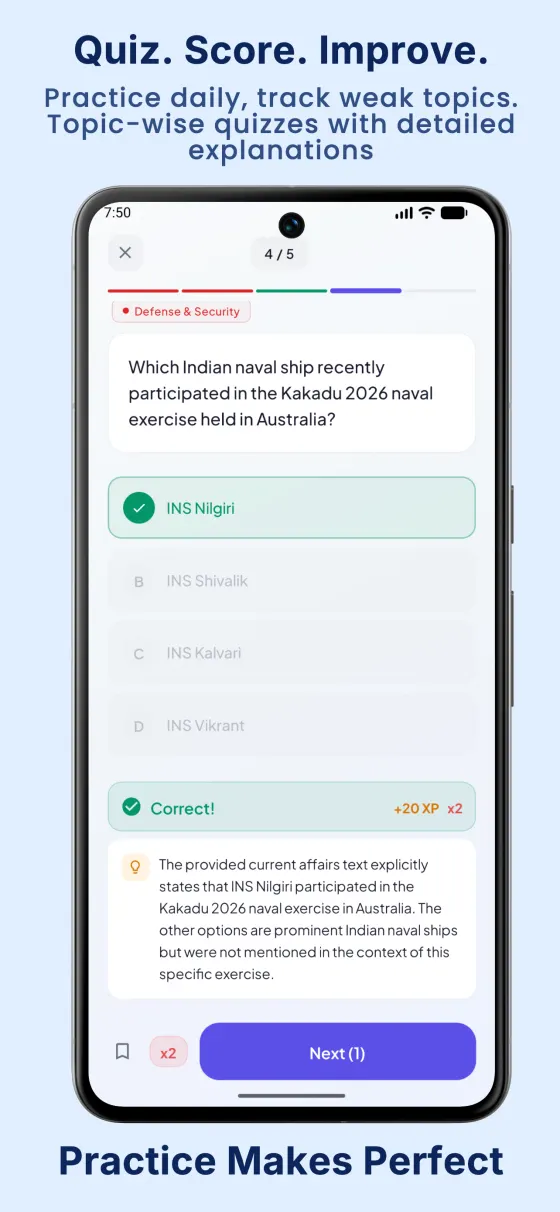
Our own app, RetainIt, is of the second kind. Its free web reader needs no sign-in and carries a handful of stories a day (typically 2 to 13), each with a summary, key points and Exam Points, in English and Hindi (the Hindi is AI-translated); the Android app adds daily MCQs with explanations. It isn't full news coverage, and its AI summaries carry no source links, so use it after your newspaper rather than instead of one, and check key facts on PIB.
News and newspaper apps compared
Downloads, labels and update dates are from each app's Google Play India listing on 28 September 2026. "No" means Play didn't show that label.
| App | What it is | Downloads | Ads | In-app purchases | Updated |
|---|---|---|---|---|---|
| The Hindu | Paper's news app | 10M+ | Yes | Yes | 4 Sep 2026 |
| The Hindu ePaper | Replica e-paper | 1M+ | No | Yes | 11 Sep 2026 |
| Indian Express | News and e-paper | 1M+ | Yes | Yes | 16 Sep 2026 |
| NewsOnAir | AIR text and audio news | 5M+ | No | No | 12 Jul 2026 |
| PIB | Press releases | 50K+ | No | No | 17 Aug 2026 |
| Google News | Aggregator | 1B+ | Yes | No | 23 Sep 2026 |
| Inshorts | 60-word summaries | 10M+ | Yes | No | 15 Sep 2026 |
| Dailyhunt | Aggregator, 14 languages | 100M+ | Yes | Yes | 30 Jun 2026 |
| DD News (old app) | Doordarshan news | 1M+ | No | No | 2 Oct 2019 |
Newspaper apps worth installing
The Hindu's app promises short news, e-paper access, Hindi updates and business news; it shows ads, and its Premium tab carries Briefing, a subscriber-only feature. The Hindu ePaper is a separate app with the page-by-page replica and no ads label. The Indian Express app lists news, Express Explained, opinion and the e-paper, but UPSC Key and premium stories still need a subscription.
Best for: readers of that paper who'd rather read on a phone. For free apps, NewsOnAir and PIB (above) show neither an ads label nor an in-app purchases label.
Why Inshorts, Google News and Dailyhunt aren't enough on their own
Inshorts summarises each story in 60 words or less, in English or Hindi, with a tap through to the original and short "Insights" explainers on big stories. Its categories also cover entertainment, cricket and a finance feed with live stock prices. Its listing pitches it as a companion for competitive exams, but sixty words gives you a headline fact, not the background or arguments that UPSC Mains and essay questions need.
Best for: a five-minute headline check before you open the paper.
Google News builds a personalised feed with Your Briefing and local news. Its Full Coverage view, which lays out one story from several outlets, is useful for comparing how two papers handled an issue. But the feed follows your clicks, so exam topics can be crowded out by whatever you tapped last.
Best for: seeing one big story from several angles.
Dailyhunt aggregates news and videos in English, Hindi and 12 other languages, and sells a Premium tier with 9,000+ magazines and e-newspapers and no ads (we didn't check its price). Its own listing puts "viral cards" and categories such as entertainment, astrology and fashion alongside the news, and the app was last updated on 30 June 2026.
Best for: news in a regional language, not exam preparation.
How to read the newspaper for UPSC and other exams in 45 to 60 minutes
We haven't timed this ourselves. It's how the usual advice fits into an hour, with the editorial page given the most time. SSC and railway aspirants can stop after the national pages. Two habits undo it: reading a second paper every day, and copying whole paragraphs into notes.
What to read
- Front page. The three or four national stories that matter.
- National and government pages. Cabinet decisions, bills, court rulings, new schemes, appointments to constitutional and statutory bodies.
- Editorial and op-ed page. One editorial and one op-ed on a syllabus topic (UPSC and State PCS).
- Economy and business. RBI, inflation, the budget, trade and banking. Bank aspirants should read this first.
- International. India's relations with other countries, summits, agreements and international bodies.
- Science, environment and health. Missions, species, climate talks and disease outbreaks.
What to skip
- City, district and crime pages
- Political statements, rallies and party quarrels
- Entertainment, lifestyle and celebrity news
- Match reports, stock tables and company results
- Supplements and advertisements
- A running story you've already noted, unless something has changed
How to make notes from the newspaper
- One line per issue. What happened, which body, the key number, the date.
- A syllabus tag. GS2 or GS3 for UPSC; Polity, Economy, Awards or Sports for SSC.
- One question. Write a question whose answer is in your line, to answer later without looking.
- A check mark. Flag the facts to confirm on PIB or RBI before they go into final notes.
- One card per running story. A dated timeline, not a new note every time it's in the paper.
Don't copy paragraphs. If a note is longer than two lines, you're rewriting the paper. Answering your own questions later does more than rereading the notes; our guide on why answering questions beats rereading explains why.
A sample 50-minute routine
| Minutes | What to do |
|---|---|
| 0 to 5 | Scan the front page and headlines; mark six to eight stories |
| 5 to 20 | National and government pages |
| 20 to 35 | One editorial and one op-ed |
| 35 to 42 | Economy, international, science and environment |
| 42 to 50 | Notes: one line, a tag and a question per story; list facts to check on PIB |
Once a week, take 30 minutes to answer that week's questions without looking, then check them. At month end, do the same for the month, or use a monthly compilation to catch what you missed; our guide to current affairs magazines compares the options.
Practise on today's current affairs
Read each day's summaries free in English or Hindi, no sign-up needed. The RetainIt app adds daily MCQs with explanations, brings back the questions you miss, and shows your weakest topics. Free on Android, no ads.
Frequently asked questions
Which newspaper is best for current affairs for UPSC?
The Hindu or The Indian Express; read one of them, not both. The Hindu is strongest for editorials and op-eds, while The Indian Express has its Explained section and a daily UPSC Key that maps its stories to the syllabus. On 28 September 2026, The Hindu's digital pass cost ₹2,799 a year and The Indian Express's UPSC Essentials plan ₹1,499 a year.
Should I read The Hindu or The Indian Express, or both?
Read one. Both cover the same major stories, so a second paper mostly repeats the first and can double your reading time. Choose The Indian Express if you're a beginner or want syllabus mapping and a cheaper plan, and The Hindu if editorials are your weak spot or you'd use BusinessLine for bank exams.
Is the Indian Express UPSC Key free?
No. UPSC Key articles are marked Premium and stop after the opening lines. They need the UPSC Essentials plan, from ₹1,499 a year on 28 September 2026; the cheaper Express Edge plan, from ₹1,299, doesn't include the UPSC section. One Explained article we opened was free.
How much does The Hindu subscription cost in 2026?
On 28 September 2026, The Hindu's digital All Access Pass cost ₹2,799 for one year, ₹4,999 for two years, or ₹3,399 a year with two extra accounts, GST included. It covers The Hindu and its e-paper, BusinessLine and its e-paper, Frontline, Sportstar and The Hindu Crosswords. The subscription page offers a full refund if you ask within 7 days.
Which newspaper is best for SSC and railway exams?
You don't need one. A daily current affairs source that picks out exam facts, checked against PIB, covers SSC and railway general awareness. If you like a paper, 20 to 30 minutes on the front and national pages of any national daily, English or Hindi, is enough.
Which newspaper is best for bank exams?
The business pages of The Hindu or The Indian Express cover most of what bank exams ask. For RBI Grade B or deeper economy coverage, add BusinessLine (inside The Hindu's ₹2,799 pass) or Business Standard (₹2,700 a year on 28 September 2026). Take policy figures from RBI's own press releases.
Which Hindi newspaper is best for UPSC and State PCS?
For UPSC analysis, read Jansatta and The Hindu's editorials in Hindi, which The Hindu publishes at thehindu.com/hindi/editorial/. For state news, read your state's paper: Amar Ujala for UP and Uttarakhand, Hindustan for Bihar and Jharkhand, and Rajasthan Patrika or Dainik Bhaskar for Rajasthan. Dainik Jagran's national pages suit SSC and general awareness.
Which news app is best for current affairs?
Use your newspaper's own app (The Hindu or The Indian Express) for depth, and NewsOnAir for free news in Hindi and English with no ads or in-app purchases; PIB's app helps you check facts. Inshorts and Google News are fine for headlines but too thin, and too shaped by your clicks, to be your only source. For exam-tagged current affairs with quizzes, use an exam current affairs app rather than a news app.
How long should I read the newspaper each day?
Give it 45 to 60 minutes for UPSC and State PCS, and 20 to 30 minutes, if you read one at all, for SSC, railway and bank exams. If it's taking two hours or more, you're reading pages you can skip (city, crime, entertainment, match reports) or copying too much into notes.
Which newspapers and news sources can I read for free?
PIB, NewsOnAir, DD News's website and RBI's press releases are free and need no login. On 28 September 2026, Navbharat Times's e-paper was free until its new plans launch, Jansatta's Delhi e-paper (front and editorial pages) and page 1 of Amar Ujala's opened without a login, and both Hindi editorials of The Hindu we opened were free. Dainik Jagran's website is free to browse, though its e-paper is paid. Our own free web reader (RetainIt, our product) has a few exam-tagged stories a day in English and Hindi, with no sign-in.